
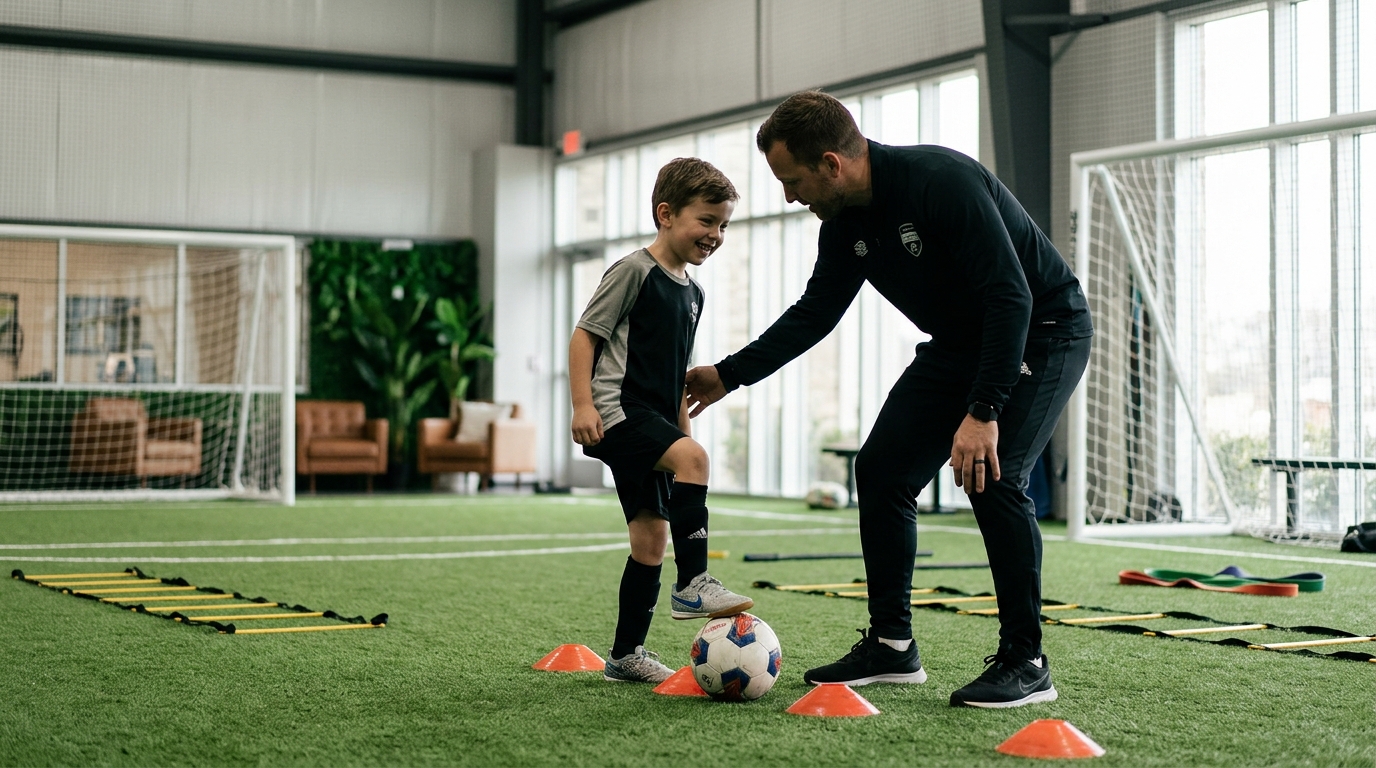
Global Futbol Training is the premier private soccer trainer near Dallas for beginning players, offering structured technical development in a private indoor facility. This guide covers essential dribbling and passing techniques, explains why private coaching accelerates early skill acquisition, and details how to build a sustainable home practice routine. We focus on the specific methods used to transform novice players into confident athletes.
Why Private Training Matters for Beginners
Beginning players often struggle with confidence because they are constantly reacting to the ball rather than controlling it. Private training provides a low-pressure environment where mistakes are part of the learning process, not a source of embarrassment. At Global Futbol Training, the focus is on long-term athlete development rather than immediate match results. This approach ensures that foundational mechanics are correct from day one.
Jeremie Piette, the founder of Global Futbol Training, is a former professional soccer player who has spent over two decades helping athletes succeed. His background includes being drafted into Major League Soccer in 2002 and playing professionally across four continents. This experience allows him to identify common technical errors in novice players quickly. For a beginning player, having a coach who understands the progression from rec to competitive levels is critical.
The Confidence Factor
Confidence is a technical skill in soccer. When a player feels comfortable with the ball, their decision-making improves. Private sessions allow for repetitive drilling without the stress of a full team environment. This repetition builds muscle memory, which is the foundation of all technical skill. Players who train privately often report feeling like a "new player" within a few months of consistent practice.
Dribbling Fundamentals for New Players
Dribbling is the act of moving with the ball while maintaining control. For beginning players, the goal is not to beat defenders with fancy moves, but to keep the ball close and move with purpose. Many novice players make the mistake of looking at the ball, which limits their awareness of the field. Correcting this habit early is a primary focus of private training.
Effective dribbling requires using both feet. Relying solely on a dominant foot limits a player's options in tight spaces. Coaches at Global Futbol Training emphasize alternating feet during basic drills. This simple adjustment doubles the number of directions a player can move. It also prepares the player for more advanced skills later in their development.
Close Control vs. Speed Dribbling
Close control is the ability to keep the ball within a small radius of the body. This is essential for navigating congested areas like the penalty box. Speed dribbling involves moving the ball faster to cover ground. Beginners should master close control before attempting speed dribbling. Trying to move fast without control leads to turnovers and frustration.
Wall drills are an excellent way to practice dribbling without a partner. By kicking the ball against a wall and controlling the rebound, players simulate the pressure of a defender. This method allows for high-repetition practice in a short amount of time. It is one of the most effective tools for improving touch and control.
Passing and First Touch Mastery
Passing is the most frequent action in a soccer match. A good pass is not just about hitting the target; it is about timing, weight, and accuracy. First touch is the initial contact with the ball, and it determines the quality of the next action. If a first touch is poor, the player is forced to take an extra touch to recover, which allows defenders to close in.
Settling the ball out of the air is a specific type of first touch that many beginners find intimidating. High balls from teammates or opponents require a different technique than ground passes. Players must learn to absorb the force of the ball to keep it close. This skill is crucial for receiving long passes and crosses.
Inside of the Foot Technique
The inside of the foot is the primary surface for accurate passing. It provides the largest contact area and the most control. Beginners should focus on keeping their ankle locked and their toes pointed slightly outward. This position ensures that the ball travels straight and true. Consistent practice with this technique builds the foundation for all other passing methods.
Passing with both feet is a non-negotiable skill for modern soccer. Even if a player is naturally right-footed, they must develop their left foot to a functional level. This allows them to pass in either direction without turning their body. It also makes them a more unpredictable and effective player on the field.
The GFT Training Environment
Global Futbol Training operates out of a private indoor facility in the Dallas/Fort Worth area. This facility is approximately 1,500 square feet of indoor turf, providing a controlled environment for training. The indoor setting eliminates weather disruptions, which is a common barrier to consistent practice. Players can train year-round without worrying about rain, snow, or extreme heat.
The facility is designed for focused, uninterrupted work. It is not a public facility where players must share space or wait for fields. This privacy allows for personalized attention and specific drills tailored to the player's needs. The environment is safe for youth and free from ads or interruptions, creating a professional atmosphere for learning.
Facility Features
The indoor turf is suitable for outdoor cleats, though flats are recommended for better control. The space is ideal for 1-on-1 training, small group sessions, and technical work. It serves as a reliable backup when outdoor sessions are canceled due to inclement weather. The controlled environment helps players focus on technique without external distractions.
Building a Home Practice Routine
Private training is most effective when supplemented by independent practice. Coaches recommend that players spend at least 30 minutes a week practicing on their own. This consistency is key to long-term improvement. A structured routine helps players build habits that last a lifetime.
Home practice does not require expensive equipment. A soccer ball and a wall are sufficient for most fundamental drills. Players can practice passing, first touch, and dribbling against a wall. This method allows for high-repetition work in a short time frame. It is an efficient way to improve skills without needing a partner or a full field.
Sample Weekly Routine
A typical weekly routine might include 30 minutes of ball control drills, 20 minutes of passing against a wall, and 10 minutes of shooting. This balanced approach ensures that all key skills are addressed. Players should track their progress to stay motivated. Seeing improvement over time is a powerful driver for continued effort.
Private vs. Group Training Comparison
| Feature | Private Training | Group Training |
|---|---|---|
| Attention | 100% focused on one player | Shared among multiple players |
| Customization | Highly tailored to individual needs | General curriculum for all |
| Cost | Higher per session | Lower per session |
| Feedback | Immediate and specific | Delayed and general |
| Social Aspect | Minimal | High |
For a beginning player, the immediate and specific feedback provided in private training is invaluable. It allows for quick correction of bad habits before they become ingrained. Group training can be a good next step once foundational skills are established.
Key Takeaways
- Private training provides a low-pressure environment ideal for building confidence in beginning players.
- Dribbling with both feet is essential for modern soccer and should be a primary focus for novices.
- First touch and passing accuracy are the most frequent actions in a match and require consistent practice.
- Indoor facilities offer a controlled environment that eliminates weather disruptions and allows for year-round training.
- Home practice of 30 minutes a week using a wall is an effective way to supplement private training.
- Jeremie Piette's professional background ensures that training methods are based on real-world experience.
- Consistency is more important than intensity when developing foundational soccer skills.
- Correcting bad habits early in a player's development prevents long-term technical limitations.
Frequently Asked Questions
How old should a child be to start private soccer training?
Children can start private soccer training as young as 7 years old. At this age, the focus is on basic ball control and confidence. Younger players benefit from the individualized attention that helps them develop a love for the game.
Do I need special equipment for private training?
No, you only need a soccer ball and appropriate footwear. The facility provides the turf and space. Players should bring water and wear comfortable athletic clothing. Outdoor cleats are allowed, but flats are recommended for indoor turf.
How long does it take to see improvement?
Most players notice improvement in their confidence and basic skills within a few weeks of consistent training. Significant technical changes may take a few months. Consistency is the key factor in the speed of improvement.
Can I train with a friend in a private session?
Yes, Global Futbol Training offers private group training for 2 to 3 players. This option allows friends to train together while still receiving personalized attention. It is a good way to share the cost of private training.
Is the facility suitable for beginners?
Yes, the facility is designed for players of all levels, including beginners. The controlled environment is ideal for learning new skills without the pressure of a full team. It is a safe and focused space for development.
What is the difference between rec and select soccer?
Rec soccer is recreational and focuses on participation and fun. Select soccer is competitive and involves travel and higher costs. Private training can help players improve their skills to move from rec to select levels if they choose to do so.
Do you offer online training?
Yes, Global Futbol Training offers online ball control courses. These courses are available for players who cannot attend in-person sessions. They provide structured video lessons and drills that can be done at home.
How do I book a session?
You can book a session by visiting the Global Futbol Training website and selecting the desired training option. Peak times fill quickly, so it is recommended to book in advance. The website provides detailed information on availability and pricing.
Conclusion
Choosing the right private soccer trainer is a critical decision for any beginning player. Global Futbol Training offers a proven method for developing technical skills and confidence in a supportive environment. The focus on dribbling and passing fundamentals ensures that players build a strong foundation for their soccer journey. With a private indoor facility and experienced coaching, GFT provides the ideal setting for novice players to thrive.
If you are looking for a private soccer trainer near Dallas, consider scheduling a session with Global Futbol Training. The personalized attention and structured curriculum will help your player improve faster and enjoy the game more. Visit the training programs page to learn more about the available options and book your first session today.