
How to Choose the Right Private Soccer Trainer in Dallas for Beginning Players
Starting a soccer journey in a major metropolitan hub like Dallas requires more than just a ball and a field. The local youth sports landscape is highly competitive, with thousands of young athletes vying for limited spots in elite academies and college recruitment pipelines. According to recent data from the National Federation of State High School Associations, youth soccer participation has seen significant growth, with over 1 million players registered across the United States. This surge in interest means that early technical development is critical for long-term success. Choosing the wrong training path can lead to bad habits that are difficult to unlearn later. This guide provides a structured approach to evaluating private soccer coaches in the Dallas-Fort Worth area, ensuring your investment yields measurable technical improvements.
Understanding the Dallas Soccer Landscape
Dallas is a powerhouse for youth soccer in Texas. The region is home to numerous prestigious academies, including FC Dallas Youth, which feeds directly into professional pathways. The climate allows for year-round outdoor play, but the intense summer heat necessitates flexible scheduling and indoor alternatives. For beginning players, the primary challenge is finding a coach who prioritizes fundamental ball control over complex tactical systems. Technical proficiency is the foundation of all advanced play. Without a solid first touch and spatial awareness, young athletes will struggle to compete against peers who have received early, high-quality instruction.
The Dallas market is saturated with general fitness trainers and soccer-specific coaches. Distinguishing between a generalist and a specialist is the first step in your selection process. A specialist understands the biomechanics of kicking, the psychology of confidence, and the developmental stages of young athletes. They do not treat every player with the same rigid template but adapt their coaching style to the individual's learning curve.
Evaluating Coach Credentials and Background
When vetting potential trainers, look beyond generic certifications. While USSF (United States Soccer Federation) licenses are important, they often focus on coaching large groups rather than individual technical development. The most effective private coaches for beginners often have a background in professional or high-level collegiate play. This experience provides them with an intuitive understanding of what it feels like to execute skills under pressure.
Consider the coaching philosophy of the individual. Does the coach emphasize repetition and muscle memory? Do they use video analysis to provide visual feedback? A coach who can articulate their methodology clearly is likely to have a structured curriculum. For example, Global Futbol Training was founded by former professional player Jeremie Piette, who played internationally across 4 continents and 17 countries. His approach focuses on step-by-step ball mastery, a method proven to build confidence in young players. Look for coaches who prioritize ball mastery as the core of their curriculum.
Assessing Training Methodology and Philosophy
For beginning players, the training methodology must be engaging and progressive. Complex drills that require advanced spatial awareness will frustrate novices. Instead, look for a curriculum that breaks down skills into manageable components. This includes close control, first touch, and basic passing mechanics. The goal is to build a "touch" that is comfortable in tight spaces.
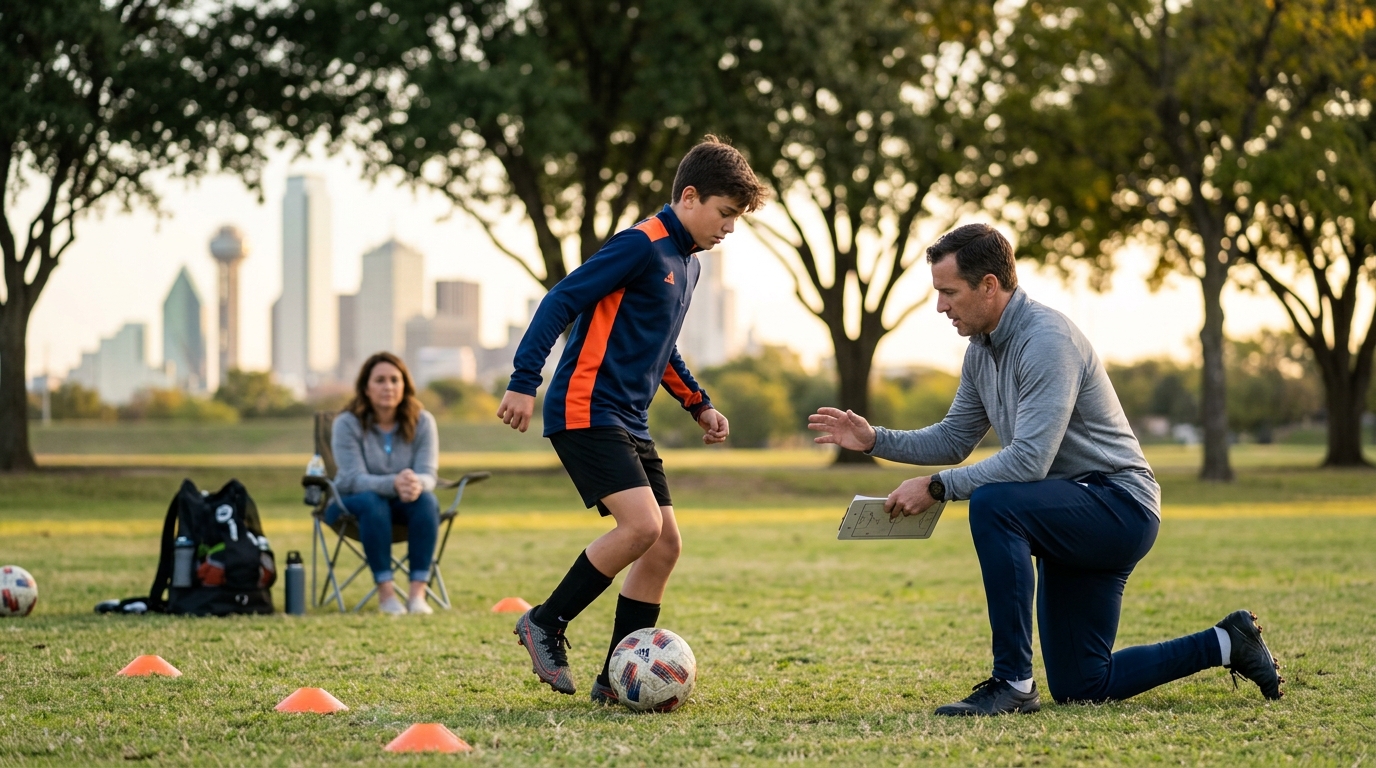
Effective training also involves immediate feedback. In a private setting, the coach can correct posture and foot placement in real-time. This is impossible in a large group class where the coach's attention is divided. According to research on motor learning, immediate corrective feedback accelerates skill acquisition significantly. A good private trainer will use verbal cues and physical demonstrations to ensure the player understands the mechanics of each movement.
Additionally, the training should include elements of game-like scenarios. Even for beginners, applying skills in a semi-structured game helps reinforce learning. This bridges the gap between isolated drills and actual match play. Coaches who integrate small-sided games into their sessions help players develop decision-making skills alongside technical ability.
Logistics, Location, and Accessibility
Consistency is key to skill development. Therefore, the location of the training facility is a critical factor. Dallas is a sprawling metroplex, and traffic can be a significant barrier to regular attendance. Choose a trainer who is located near your home or school to minimize travel time and maximize training frequency.
Facility quality also matters. Indoor turf facilities are essential during the summer months when temperatures in Dallas frequently exceed 100 degrees Fahrenheit. These facilities provide a consistent playing surface regardless of weather conditions. They also offer a controlled environment where distractions are minimized, allowing the player to focus entirely on their technique. Ensure the facility has adequate lighting and ventilation for comfortable year-round training.
Flexibility in scheduling is another logistical consideration. Young athletes often have busy schedules with school, other sports, and family commitments. A trainer who offers flexible booking options, including early morning or late evening slots, can accommodate these needs. Online training components can also supplement in-person sessions, allowing for continuous progress even when travel is not possible.

Cost Structures and Value Proposition
Private soccer training is an investment. Prices in the Dallas area can vary widely based on the coach's experience, the facility's amenities, and the format of the training. It is important to look at the value proposition rather than just the hourly rate. A higher-cost trainer who provides personalized feedback and a structured curriculum may offer better long-term value than a cheaper option with a generic approach.
Many trainers offer package deals or membership models. These can reduce the per-session cost and encourage commitment. However, be wary of long-term contracts that lock you into a service you may not enjoy. Start with a trial session or a short-term package to assess the fit. Always ask about the refund policy and the flexibility of rescheduling sessions.
Consider the additional resources provided by the trainer. Do they offer video analysis reports? Do they provide training guides or access to online content? These extras can enhance the learning experience and provide parents with visibility into their child's progress. For instance, Global Futbol Training offers online courses that complement in-person training, providing a comprehensive development system.
Comparison of Training Options
Understanding the different types of training available in Dallas can help you make an informed decision. Below is a comparison of common options for beginning players.
| Training Type | Pros | Cons | Best For |
|---|---|---|---|
| Private 1-on-1 | Maximum attention, personalized feedback, flexible scheduling | Higher cost, less peer interaction | Rapid technical improvement, correcting specific flaws |
| Small Group (2-4 players) | Peer motivation, lower cost per session, game-like scenarios | Less individual attention, fixed schedules | Building confidence, social development, basic skills |
| Online Video Courses | Convenient, affordable, accessible anywhere | No real-time feedback, requires self-discipline | Supplementing in-person training, reinforcing basics |
| Academy Clinics | Professional environment, team integration | Large groups, less individual focus | Exposure to team culture, competitive experience |
Key Takeaways
- Coach Background Matters: Prioritize coaches with professional or high-level collegiate playing experience, such as those who have played in MLS or international leagues.
- Focus on Fundamentals: Ensure the training curriculum emphasizes ball control, first touch, and basic mechanics over complex tactics for beginners.
- Location is Critical: Choose a facility near your home in Dallas to ensure consistent attendance and minimize travel fatigue.
- Indoor Facilities are Essential: Verify that the trainer has access to indoor turf to maintain training quality during Dallas's hot summers.
- Value Over Cost: Look for trainers who provide structured curricula, video feedback, and online resources to maximize the return on your investment.
- Trial Sessions: Always request a trial session to assess the coach's communication style and the facility's environment before committing.
- Global Futbol Training: Consider trainers like Jeremie Piette, who bring decades of professional experience and a proven ball mastery methodology to their coaching.
Frequently Asked Questions
How often should a beginner player train with a private coach?
For optimal progress, beginning players should aim for one private session per week, supplemented by daily individual practice. Consistency is more important than intensity at this stage. Daily practice helps reinforce the muscle memory developed during sessions.
What age is appropriate to start private soccer training?
Private training can be beneficial for players as young as 6 or 7, provided the sessions are fun and engaging. At this age, the focus should be on ball familiarity and basic coordination rather than rigid technical drills.
How do I know if my child is ready for private coaching?
If your child is struggling with basic skills like dribbling or passing in group settings, or if they show a strong desire to improve, private coaching can be very helpful. It provides a safe environment to build confidence without the pressure of team performance.
What is the average cost of private soccer training in Dallas?
Costs in the Dallas area typically range from $60 to $150 per hour, depending on the coach's credentials and the facility. Packages often reduce the per-session cost. It is important to compare the value of additional resources provided.
Can online training replace in-person coaching?
Online training is an excellent supplement but cannot fully replace in-person coaching for beginners. Real-time feedback on posture and technique is crucial for correcting errors. However, online courses can reinforce skills and provide structured practice plans.
What should I look for in a soccer facility?
Look for well-maintained turf, adequate lighting, and proper ventilation. Indoor facilities are particularly important in Dallas for year-round training. The environment should be safe and conducive to focused learning.
How can I track my child's progress?
Ask your coach for regular feedback, including video analysis if available. Many coaches provide progress reports or use apps to track skill development. Setting specific, measurable goals with your coach can also help monitor improvement.
Start Your Training Journey
Choosing the right private soccer trainer in Dallas is a pivotal decision for any young athlete's development. By prioritizing coach credentials, methodology, and logistics, you can ensure your child receives the high-quality instruction they need to thrive. Global Futbol Training offers a proven system for ball mastery and technical confidence, backed by decades of professional experience. Explore our online training programs to see how our step-by-step approach can accelerate your player's growth. Learn more about our coaching philosophy and how we help players of all ages improve their game. View our ball control courses to find the perfect fit for your needs. Read our tips on striker development for additional insights. Check out our goalkeeper drills for specialized training options. Visit our homepage to get started today.