

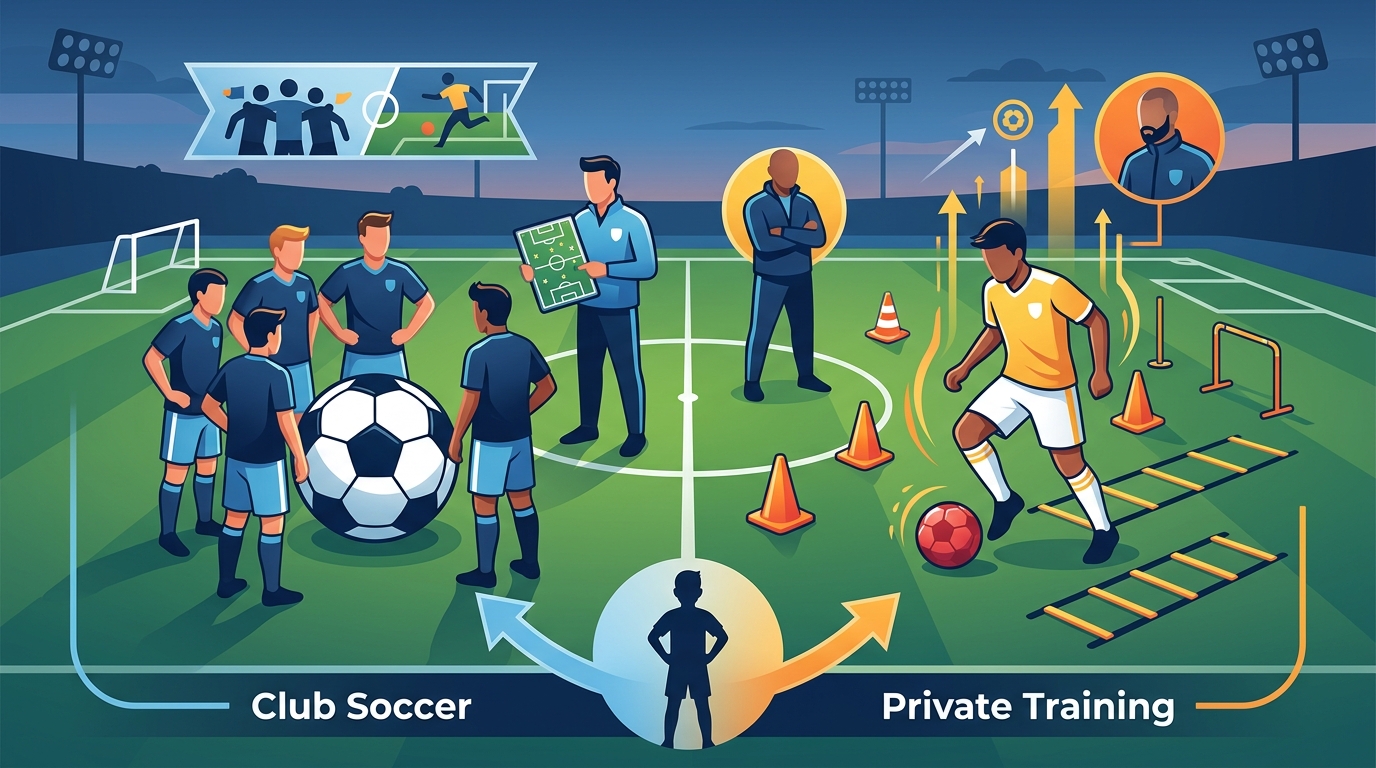
Choosing the right development path for a young athlete is one of the most critical decisions a family makes in youth sports. The debate between club soccer and private training often centers on cost, time commitment, and the specific technical gaps a player needs to address. While club soccer provides essential competitive experience and team dynamics, private training offers the hyper-focused repetition required to master individual ball control. Understanding the unique value proposition of each method is the first step toward building a successful soccer career. (ABOUT Global Futbol Training)
The Club Soccer Foundation
Club soccer serves as the primary ecosystem for youth development in North America. It provides a structured environment where players learn tactical awareness, positional discipline, and the ability to perform under competitive pressure. According to data from the Soccer America industry reports, club soccer remains the dominant pathway for identifying talent for collegiate and professional programs. The value lies not just in technical skill, but in the social and psychological aspects of team sports. (ABOUT Global Futbol Training)
Players in club settings learn to read the game in real-time. They develop spatial awareness by interacting with teammates and opponents who are constantly moving. This environment is irreplaceable for learning how to apply technical skills during a match. However, the coach-to-player ratio in club settings often limits the amount of individual repetition each athlete receives. A coach managing fifteen players cannot correct every individual's first touch or body orientation during a ninety-minute session. (Global Futbol Training Soccer)
Furthermore, club soccer schedules are rigid. Practices are typically held two to three times a week, with games on weekends. This structure provides consistency but leaves little room for addressing specific technical deficiencies that require more frequent, targeted intervention. The U.S. Soccer development pathways emphasize that club play is essential for competitive readiness, but it is rarely sufficient for elite technical mastery alone.
The Private Training Advantage
Private training, particularly when led by former professional players, offers a different kind of value. The core benefit is the elimination of distractions. In a private or small-group setting, the focus is entirely on the athlete's mechanics. This allows for immediate feedback and correction, which is crucial for neuroplasticity and skill acquisition. Global Futbol Training was founded by Jeremie Piette, a former professional player who understands the exact technical nuances required to succeed at higher levels.
Private training allows for the isolation of specific skills. A player struggling with aerial control can dedicate an entire session to that single element without the pressure of a game scenario. This method accelerates the learning curve because the repetition is high-quality and focused. Players who engage in consistent private training often report faster improvements in their first touch and confidence on the ball compared to those relying solely on team practice.
Additionally, private training can be tailored to the player's schedule. Whether a family is traveling or has a busy academic week, online or flexible in-person sessions can fill the gaps. This adaptability ensures that development does not stall during off-seasons or busy periods. The NCAA recruitment landscape is highly competitive, and players who demonstrate refined individual skills often stand out to college coaches during evaluations.
Comparing Development Outcomes
When evaluating which path is better, it is helpful to look at the specific outcomes each method produces. Club soccer excels at producing game-ready athletes. It teaches players how to communicate, how to support teammates, and how to handle the emotional highs and lows of competition. These are soft skills that are difficult to teach in a vacuum.
Private training excels at producing technically superior athletes. It focuses on the biomechanics of movement, the precision of ball contact, and the consistency of execution. The goal is to make technical skills automatic, so the player can focus on tactical decisions during a game. This distinction is vital for parents who want to understand that these two methods are complementary, not mutually exclusive.
| Feature | Club Soccer | Private Training |
|---|---|---|
| Primary Focus | Tactics, Teamwork, Competition | Technical Skill, Mechanics, Repetition |
| Coach Attention | Low (High Player-to-Coach Ratio) | High (Individual or Small Group) |
| Feedback Loop | Delayed (Post-game or end of practice) | Immediate (Real-time correction) |
| Flexibility | Rigid Schedule | Adaptable (Online or In-Person) |
| Best For | Game Experience & Social Development | Technical Mastery & Confidence |
Research in sports pedagogy suggests that deliberate practice, a hallmark of private training, is more effective for skill acquisition than unstructured play. However, the transfer of these skills to a game context requires the competitive environment provided by club soccer. Therefore, the most successful players often utilize a hybrid approach. They use club soccer to test their skills and private training to refine them.
Cost and Time Investment
Both paths require significant financial and temporal resources. Club soccer fees can range from hundreds to thousands of dollars per season, depending on the region and the level of the club. Travel costs for tournaments and away games add to this expense. Time commitment includes weekly practices and weekend games, which can total ten to fifteen hours per week during the season.
Private training costs vary based on the format. In-person sessions with elite coaches are typically priced at a premium due to the specialized expertise. Online training programs, such as those offered by Global Futbol Training, offer a more accessible entry point for families seeking high-quality instruction without the travel burden. These programs provide structured curricula that guide players through progressive skill levels.
When calculating the return on investment, families should consider the long-term goals of the athlete. If the goal is collegiate recruitment, the combination of club visibility and private technical refinement is often the most effective strategy. The National Collegiate Athletic Association guidelines for recruiting emphasize both academic performance and athletic ability, making a balanced development approach essential.
Key Takeaways
- Club Soccer provides essential competitive experience and tactical awareness that cannot be replicated in isolation.
- Private Training offers immediate feedback and high-volume repetition, accelerating technical skill acquisition.
- Jeremie Piette, founder of Global Futbol Training, brings professional experience from MLS and international play to his coaching methodology.
- Hybrid Approach is recommended for elite development, using club for game context and private training for technical refinement.
- Online Options like the Complete Ball Mastery Bundle provide flexible, high-quality instruction for players nationwide.
- Collegiate Recruitment favors players who demonstrate both technical proficiency and game intelligence.
- Cost Efficiency can be improved by using online training modules to supplement expensive in-person club fees.
Frequently Asked Questions
Is private training necessary if my child is in club soccer?
Private training is not strictly necessary for every player, but it is highly beneficial for those aiming for elite levels. Club soccer provides team context, while private training addresses individual technical gaps that coaches in large groups cannot fix.
How does online training compare to in-person coaching?
Online training offers consistency and accessibility. Programs like those at Global Futbol Training provide structured lessons that players can follow at their own pace, ensuring they receive professional instruction regardless of location.
What age is best to start private training?
Private training can be beneficial at any age. For younger players, it helps build a strong technical foundation. For older players, it refines specific skills needed for competitive success. The key is matching the training intensity to the player's developmental stage.
Can online training replace in-person club practice?
Online training should supplement, not replace, club practice. Club soccer provides the competitive environment necessary to apply skills. Online training ensures the technical skills are sharp enough to perform well in that environment.
What are the benefits of training with a former professional player?
Former professionals understand the exact demands of high-level play. They can identify subtle technical flaws that affect performance and provide actionable solutions based on their own career experiences.
How much time should be spent on private training per week?
Consistency is more important than duration. Short, focused sessions of 20 to 30 minutes, three to four times a week, are often more effective than one long weekly session. This approach keeps the skills fresh and prevents burnout.
Does private training help with college recruitment?
Yes. College coaches look for players with refined technical skills. Private training helps players develop the ball control and confidence that stand out during evaluations and tryouts.
Start Your Training
Whether you choose club soccer, private training, or a combination of both, the goal is the same: to help your player reach their full potential. Global Futbol Training offers a proven system for developing ball control and technical confidence. Our online courses provide the structure and expertise needed to complement your club experience. Visit our Ball Control Courses page to explore how you can accelerate your player's development today.